

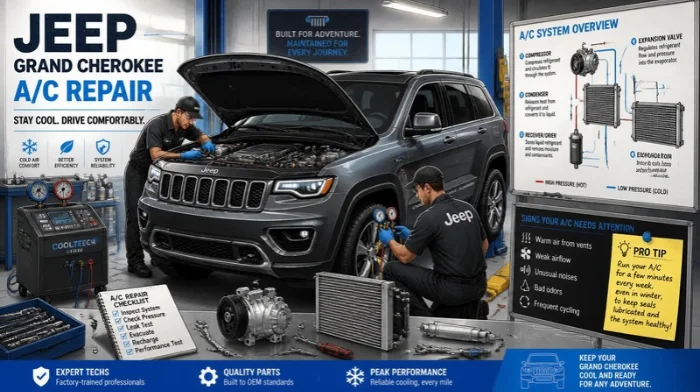
A failing A/C can turn a comfortable SUV into an unpleasant drive within minutes. Air conditioning repair Jeep Grand Cherokee problems can involve refrigerant leaks, electrical faults, actuators, fans, or compressor damage. Diagnosing the symptom first can prevent an expensive replacement that never addressed the real problem.
Direct answer: Start by checking airflow, temperature, noises, and whether cooling changes while driving. Warm air does not automatically mean the compressor has failed. Professional pressure testing and leak detection can separate a refrigerant problem from electrical, airflow, or mechanical faults before parts are replaced.
Table of Contents
Jeep Grand Cherokee A/C Repair at a Glance
| Problem or service | Common clue | Typical U.S. cost context | Best next step |
|---|---|---|---|
| Low refrigerant or recharge | Cooling weakens gradually | About $285–$367 average estimate | Test for leaks before recharging |
| Compressor failure | Noise, no cooling, pressure problems | About $803–$1,325 average estimate | Confirm failure before replacement |
| Blend-door or actuator problem | Uneven temperatures or clicking | Varies by model and access | Scan HVAC controls and inspect actuator |
| Condenser or evaporator leak | Refrigerant repeatedly becomes low | Varies widely by failed component | Leak-test the sealed system |
| Electrical or software fault | Compressor does not engage | Diagnosis varies | Check codes, power, fuses, and updates |
| Cabin airflow problem | Weak vent output | Usually depends on filter or blower issue | Inspect filter and blower operation |
Current RepairPal estimates place a Grand Cherokee A/C recharge around $285 to $367. Its compressor estimate runs roughly $803 to $1,325 across the model line. Actual bills depend on model year, labor rates, diagnosis, refrigerant type, and related damage.
Key Takeaways
- Diagnose before approving a compressor replacement.
- A recharge cannot permanently fix an active refrigerant leak.
- Weak airflow and warm airflow point toward different problems.
- Electrical or software faults can imitate mechanical A/C failure.
- Refrigerant work belongs with properly equipped technicians.
- Ask for test results before approving expensive parts.
What Usually Causes the A/C to Stop Cooling?
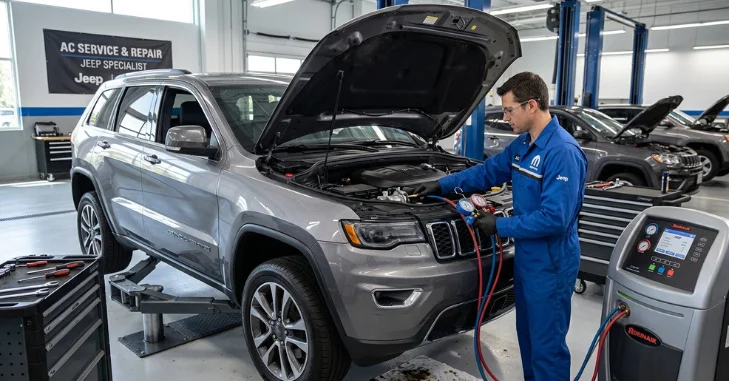
Low refrigerant is one possible cause of AC problems. When seeking air conditioning repair for a Jeep Grand Cherokee, remember that refrigerant does not normally disappear without a reason. A leaking seal, condenser, line, compressor, or evaporator can reduce system pressure. Recharging the system without finding the leak may provide only temporary cooling.
A compressor problem can also leave the vents blowing warm air. The compressor circulates refrigerant and creates the pressure changes required for cooling. Yet a nonworking compressor may result from an electrical command or control problem instead of internal failure.
Airflow faults create another group of symptoms. A dirty cabin filter can reduce airflow, while a blower fault can stop air movement almost entirely. A blend-door actuator can also produce the wrong vent temperature even when the refrigeration circuit works.
Some vehicles can have software-related climate-control problems. FCA issued a customer satisfaction notification involving certain 2021–2022 Grand Cherokee WL vehicles. The campaign addressed HVAC software that could prevent compressor operation.
Air Conditioning Repair Jeep Grand Cherokee: 6 Diagnostic Steps
You can collect useful information before visiting a repair shop. These checks do not require opening the refrigerant circuit. They can also help a technician reproduce the problem faster.
What You’ll Need
- A safe parking location
- Your vehicle owner’s manual
- A flashlight
- Paper or a phone for recording symptoms
- A thermometer, if available
1. Check Whether Airflow Is Strong
Set the blower to several speeds and compare the airflow. Weak airflow suggests checking the cabin filter, blower, vents, or related controls first. Strong airflow with warm temperature usually points elsewhere.
2. Compare Driver and Passenger Temperatures
Set both climate zones to the same temperature, if your vehicle has dual-zone controls. A large left-to-right difference can suggest a door or actuator problem. Listen for repetitive clicking behind the dashboard while changing temperature settings.
3. Notice When Cooling Works
Compare cooling while idling and while driving at normal road speed. A noticeable difference can give the technician another diagnostic clue. Record whether the problem appears only in traffic, after warming up, or during extended driving.
4. Listen for New Mechanical Sounds
Turn the climate system off, then switch the A/C on. Listen for grinding, rattling, squealing, or other newly appearing sounds. Shut the system down if a severe mechanical noise develops.
5. Look for Obvious External Damage
Inspect the front of the vehicle for visible condenser damage or heavy debris. Do not disconnect lines or loosen A/C fittings. Refrigerant-system diagnosis requires equipment designed for safe recovery and pressure testing.
6. Request a Full A/C Diagnosis
Ask the shop to identify the failed component and show the evidence. Useful findings include pressure readings, leak-test results, fault codes, electrical measurements, or visible damage. A diagnosis is more valuable than replacing the first suspected part.
The EPA requires technicians servicing vehicle air conditioners for payment to hold Section 609 certification. They must also use approved refrigerant-handling equipment. Federal rules prohibit intentionally venting regulated refrigerants during service.
Recharge or Repair: Which One Does Your SUV Need?
A recharge restores the correct refrigerant charge after the system has become low or been opened for service. It does not repair a leaking component. If cooling fades again, the underlying leak still needs attention.
A proper service visit should determine why the charge became low. Depending on the symptom, technicians may inspect pressures, temperatures, leak evidence, electrical operation, and compressor performance. This approach reduces repeated recharge costs and unnecessary parts replacement.
Jeep’s 2021 Grand Cherokee manual lists R-134a and R-1234yf procedures depending on vehicle equipment. It recommends approved refrigerant, compressor oil, recovery equipment, and appropriate service facilities. Check the under-hood label for the exact refrigerant specified for your vehicle.
How Much Can Jeep Grand Cherokee A/C Repair Cost?
A simple service and a major component replacement can have dramatically different prices. RepairPal’s current estimate places a typical recharge around $285 to $367. Its current Grand Cherokee compressor estimate spans approximately $803 to $1,325.
Another national mobile-repair estimator lists an average Grand Cherokee compressor replacement near $1,023. Individual model and engine examples can cost considerably more. Location, parts choice, refrigerant quantity, and related component damage can change the final bill.
Treat online numbers as planning ranges rather than guaranteed quotes. A compressor that spreads debris may require additional system work. An evaporator repair can also become labor-intensive because of its location inside the HVAC housing.
Signs the Compressor May Not Be the Real Problem
Replacing a compressor without testing the system can become an expensive mistake. The compressor needs correct electrical commands and proper system conditions before it can operate normally. Control problems can therefore produce symptoms that resemble compressor failure.
For example, a 2021 FCA technical bulletin covered certain Grand Cherokee SRT models with poor cooling and abnormal compressor cycling. The prescribed repair involved a powertrain software update after proper diagnosis. That example shows why model-specific technical information matters before parts replacement.
Ask whether the shop confirmed power, ground, pressure conditions, and relevant fault codes. Also ask whether applicable campaigns or technical information were checked using your VIN. These questions encourage diagnosis without telling the technician how to perform the repair.
For broader vehicle ownership information, readers can browse Readesh’s Automobile section. Readesh also covers practical automotive topics such as headlight troubleshooting and replacement and its detailed 2011 Acura MDX ownership review.
When Should You Stop Driving and Get the A/C Checked?
Warm air alone normally does not make a vehicle immediately undrivable. Serious mechanical noises deserve more caution because a failing driven component can create additional problems. If you hear grinding or severe belt-area noise, switch the A/C off and arrange an inspection.
Cooling is also connected to visibility during humid conditions. The climate system helps remove moisture when the windshield needs defogging. A system that cannot control cabin humidity may therefore create a practical visibility concern.
Do not open refrigerant lines to investigate a cooling complaint yourself. Pressurized refrigerant requires appropriate handling procedures and recovery equipment. Professional diagnosis is the safer route when sealed-system work is required.
What to Ask Before Approving the Repair
A written estimate should identify the diagnosis and the parts being replaced. Ask whether the quote includes refrigerant recovery, evacuation, recharge, oil, seals, labor, and required related components. Also ask what warranty applies to parts and labor.
Request the reason behind any compressor recommendation. A clear explanation might reference incorrect pressures, internal noise, leakage, contamination, or failed electrical testing. “The A/C is warm” is a symptom, not proof of compressor failure.
If the first estimate is unusually expensive, a second diagnostic opinion may be worthwhile. Bring the first inspection results rather than hiding them. Comparing two evidence-based diagnoses can be more useful than comparing prices alone.
How to Reduce Future A/C Problems
Use the climate system regularly and pay attention when its behavior changes. Cooling that slowly weakens deserves inspection before the system becomes completely empty. Early diagnosis can sometimes prevent repeated service visits.
Check the cabin air filter according to the vehicle’s maintenance information. A restricted filter affects airflow, although it does not replace sealed-system diagnosis. The owner’s manual remains the best reference for vehicle-specific maintenance and approved fluids.
Avoid universal stop-leak products or unapproved refrigerant mixtures. Jeep specifically advises using manufacturer-approved refrigerants and compressor oil. Correct products protect system compatibility and service equipment.
Get the Cause Confirmed Before Buying Parts
A good A/C repair begins with evidence rather than guessing. Record the symptoms, request proper testing, and ask the shop to explain what failed. That approach can protect you from paying for a major component that was never the real cause.
For owners dealing with poor cooling, the next step is straightforward. Schedule a complete vehicle A/C diagnosis with a qualified shop before authorizing expensive parts. Bring your model year, engine information, symptoms, and any previous repair records.
Frequently Asked Questions
How much does air conditioning repair Jeep Grand Cherokee service cost?
The cost depends on what actually failed. A current recharge estimate is about $285–$367, while compressor replacement commonly reaches hundreds more. Diagnosis should come before using either range as your expected bill.
Why is my Jeep A/C blowing warm air?
Warm air can result from low refrigerant, a leak, compressor trouble, electrical faults, or climate-control problems. The symptom alone cannot identify the failed part. Pressure, electrical, and leak testing can narrow the cause.
Can I recharge the system myself?
Some consumer recharge products exist, but opening or servicing the refrigerant system has important technical and environmental considerations. Paid U.S. HVAC service requires Section 609-certified technicians and approved equipment. A professional diagnosis is especially valuable when refrigerant loss indicates a leak.
Why is one side cold and the other side warm?
Uneven temperatures may point toward a blend-door or actuator problem. Dual-zone systems use doors to manage air temperature for different cabin areas. A technician can inspect HVAC commands and actuator movement before disturbing the refrigerant circuit.
Does a warm A/C always mean the compressor is bad?
No. Low refrigerant, wiring faults, control modules, sensors, actuators, or software can create similar symptoms. Testing the complete system helps prevent an unnecessary compressor replacement.
Is an A/C recharge a permanent repair?
A recharge can restore cooling when refrigerant charge is corrected. It does not seal a leaking condenser, evaporator, line, compressor, or fitting. Repeatedly low refrigerant calls for leak diagnosis.