

Last Updated on September 2, 2026 by Nasir Hanif
Short answer: Employment law sets the legal rules for the relationship between employers and employees. It can govern hiring, pay, working time, discrimination, safety, leave, privacy, discipline, and termination. The exact protections depend on the country and often on the state, province, or city where the work takes place.
That local difference matters. A workplace practice that is lawful in one jurisdiction may be restricted in another, so general information should always be checked against the rules in the jurisdiction where the worker is employed.
| Area | What it can cover | Why it matters |
| Hiring | Job offers, contracts, worker status, background checks | Sets the legal basis of the relationship |
| Pay and hours | Wages, overtime, breaks, deductions, working time | Protects lawful compensation |
| Equality | Discrimination, harassment, accommodation | Supports fair treatment |
| Safety | Workplace hazards, health protections, reporting | Reduces preventable harm |
| Leave | Family, medical, parental, or other protected leave | Protects qualifying absences |
| Privacy | Monitoring, personal data, workplace technology | Defines limits on employer oversight |
| Termination | Notice, dismissal, retaliation, severance | Governs how employment can end |
These subjects appear across major workplace-law resource hubs, although the precise rules and remedies differ by location.
Table of Contents
Key Takeaways
- Workplace rules affect both employees and employers.
- Rights can come from statutes, regulations, contracts, and other legal sources.
- Pay, discrimination, safety, privacy, and dismissal are common areas of dispute.
- Worker classification can affect which protections apply.
- Local law matters more than a general online explanation.
- Early documentation can make a workplace problem easier to assess.
What Employment Law Covers
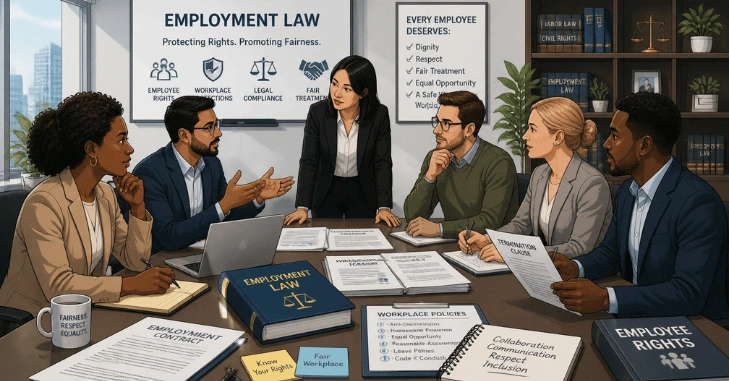
Workplace rules begin before an employee’s first day. Hiring decisions, written offers, contract terms, screening practices, and worker classification can all create legal questions.
Employment law: The rules continue throughout the employment relationship. Common subjects include wages, working hours, discrimination, harassment, benefits, privacy, health and safety, leave, and workplace discipline.
They also affect how the relationship ends. A dismissal may raise questions about notice, retaliation, contractual promises, discrimination, or unpaid compensation. The answer depends on the governing law and the facts surrounding the decision.
Worker status deserves particular attention. Legal protections may differ for employees, contractors, temporary workers, and other categories of workers. The label in an agreement may not settle the question if local law applies a different legal test.
Employee Rights and Employer Responsibilities
Employees may have rights related to fair pay, equal treatment, workplace safety, lawful leave, privacy, and protection from retaliation. Some legal systems also protect the right to organize and bargain collectively.
At the international level, the International Labour Organization identifies five fundamental categories of workplace rights. They include freedom of association, the elimination of forced labor, the abolition of child labor, the elimination of discrimination, and a safe and healthy working environment.
Employers have corresponding responsibilities under the laws that apply to them. These may include paying workers correctly, maintaining required records, addressing discrimination complaints, managing safety risks, and following lawful termination procedures.
Policies and training can support compliance, but written rules alone aren’t enough. Employers also need managers to apply those rules consistently.
For a practical example of workplace risk prevention, Readesh’s construction safety guidance addresses training, protective equipment, hazard awareness, and safer work practices.
How Workplace Rules Differ From Labor Law

The terms overlap, but they aren’t always used in the same way. In U.S. legal education, employment rules commonly focus on the individual employer-employee relationship. Labor law more often addresses unions, organizing, collective bargaining, and collective workplace action.
Terminology varies between countries. A reader should therefore check what a legal source means by “labour” or “labour” before assuming that the distinction is universal.
Why Your Jurisdiction Changes the Answer
There is no single worldwide set of workplace rules. A worker may be affected by national law as well as state, provincial, regional, or local requirements. Industry-specific regulations and contractual terms can add another layer. FindLaw likewise advises readers to check the rules that apply in their location rather than relying only on a general overview.
This is especially important when researching:
- minimum wages and overtime;
- required breaks and leave;
- discrimination protections;
- notice and dismissal;
- workplace surveillance;
- restrictive clauses in contracts;
- complaint deadlines and filing procedures.
Start with an official labor or employment regulator in your jurisdiction. Then consider professional advice when the financial or legal consequences are significant.
How AI and Workplace Technology Are Changing the Rules

Workplace technology is creating new legal questions alongside traditional disputes. Employers increasingly use automated systems in recruitment, worker management, performance assessment, and monitoring. The ILO has highlighted concerns involving equality, discrimination, transparency, worker well-being, and occupational health when AI systems are used at work.
That doesn’t mean every automated tool is unlawful. It means employers should understand what a system measures, how it makes or informs decisions, and which local rules govern its use.
Employees should also read workplace technology policies carefully. If an automated decision affects hiring, promotion, discipline, or dismissal, keep any relevant notices and communications.
What to Keep When a Workplace Problem Starts
A practical first step is to preserve accurate records. Don’t alter documents or secretly record conversations without checking whether local law permits such recording.
| Issue | Useful records to preserve | Sensible first step |
| Pay dispute | Pay slips, schedules, time records, contracts | Compare records with applicable pay rules. |
| Harassment | Messages, dates, witnesses, internal reports | Review the reporting procedure |
| Safety concern | Photos, incident reports, written notices | Use the proper safety reporting channel. |
| Dismissal | Termination letter, reviews, emails, contract | Record dates and reasons given |
| Monitoring or AI | Policies, notices, consent forms, decisions | Identify what technology was used. |
| Worker status | Contract, invoices, schedules, control records | Check the local classification test. |
Good records don’t prove that a legal violation occurred. They help a regulator, adviser, or lawyer understand what happened without relying only on memory.
When to Get Professional Legal Advice

Consider speaking with a qualified local professional when a dispute involves dismissal, discrimination, harassment, retaliation, substantial unpaid wages, a workplace injury, a restrictive contract, or formal legal proceedings.
Timing can matter because complaint processes and deadlines vary. A local adviser can identify the correct law, agency, evidence, and filing route for the situation.
Readesh also has an employment-lawyer article focused on Los Angeles that illustrates why legal guidance is more useful when tied to a specific jurisdiction.
Start With the Rules That Apply Where You Work
Workplace rights make more sense once you identify the correct jurisdiction. Check the applicable government guidance, keep clear records, and compare workplace policies with the legal minimum requirements. We cover this in more depth in Emancipation Definition.
For more general legal explainers, browse the Readesh Law section. If a dispute could affect your income, job, business, or legal rights, get advice from a qualified professional who practices where the work takes place.
Conclusion
Employment law provides the foundation for a fair and lawful relationship between workers and employers, covering important areas such as pay, working hours, discrimination, workplace safety, leave, privacy, worker classification, and termination. However, these rights and responsibilities are not identical everywhere. The rules can vary significantly depending on the country, state, province, city, industry, employment contract, and type of worker involved.
Frequently Asked Questions
It is the body of rules governing relationships between employers and employees. It may address hiring, wages, working conditions, discrimination, safety, privacy, leave, and termination. The specific rights depend on the jurisdiction.
Common issues include unpaid wages, overtime disputes, harassment, discrimination, unsafe conditions, retaliation, privacy concerns, contract disputes, and dismissal.
A workplace policy generally has to operate within the law that governs the employment relationship. Policies or contracts may provide additional benefits, but they shouldn’t be treated as a substitute for checking statutory requirements.
Not necessarily. Legal protections often depend on worker status and the jurisdiction’s classification rules. Anyone facing a serious classification dispute should check the applicable legal test rather than relying only on the label used in the contract.
Professional advice can be useful when money, employment status, discrimination, retaliation, injury, or a filing deadline is at stake. Early advice can also help identify which records and procedures matter.
What is employment law in simple terms?
It is the body of rules governing relationships between employers and employees. It may address hiring, wages, working conditions, discrimination, safety, privacy, leave, and termination. The specific rights depend on the jurisdiction.
What are common workplace legal issues?
Common issues include unpaid wages, overtime disputes, harassment, discrimination, unsafe conditions, retaliation, privacy concerns, contract disputes, and dismissal.
Can an employer’s policy override legal rights?
A workplace policy generally has to operate within the law that governs the employment relationship. Policies or contracts may provide additional benefits, but they shouldn’t be treated as a substitute for checking statutory requirements.
Do independent contractors have the same protections as employees?
Not necessarily. Legal protections often depend on worker status and the jurisdiction’s classification rules. Anyone facing a serious classification dispute should check the applicable legal test rather than relying only on the label used in the contract.
When should I contact a lawyer about a workplace issue?
Professional advice can be useful when money, employment status, discrimination, retaliation, injury, or a filing deadline is at stake. Early advice can also help identify which records and procedures matter.
Start With the Rules That Apply Where You Work
Workplace rights make more sense once you identify the correct jurisdiction. Check the applicable government guidance, keep clear records, and compare workplace policies with the legal minimum requirements.
For more general legal explainers, browse the Readesh Law section. If a dispute could affect your income, job, business, or legal rights, get advice from a qualified professional who practices where the work takes place.
This article provides general educational information and is not legal advice.