

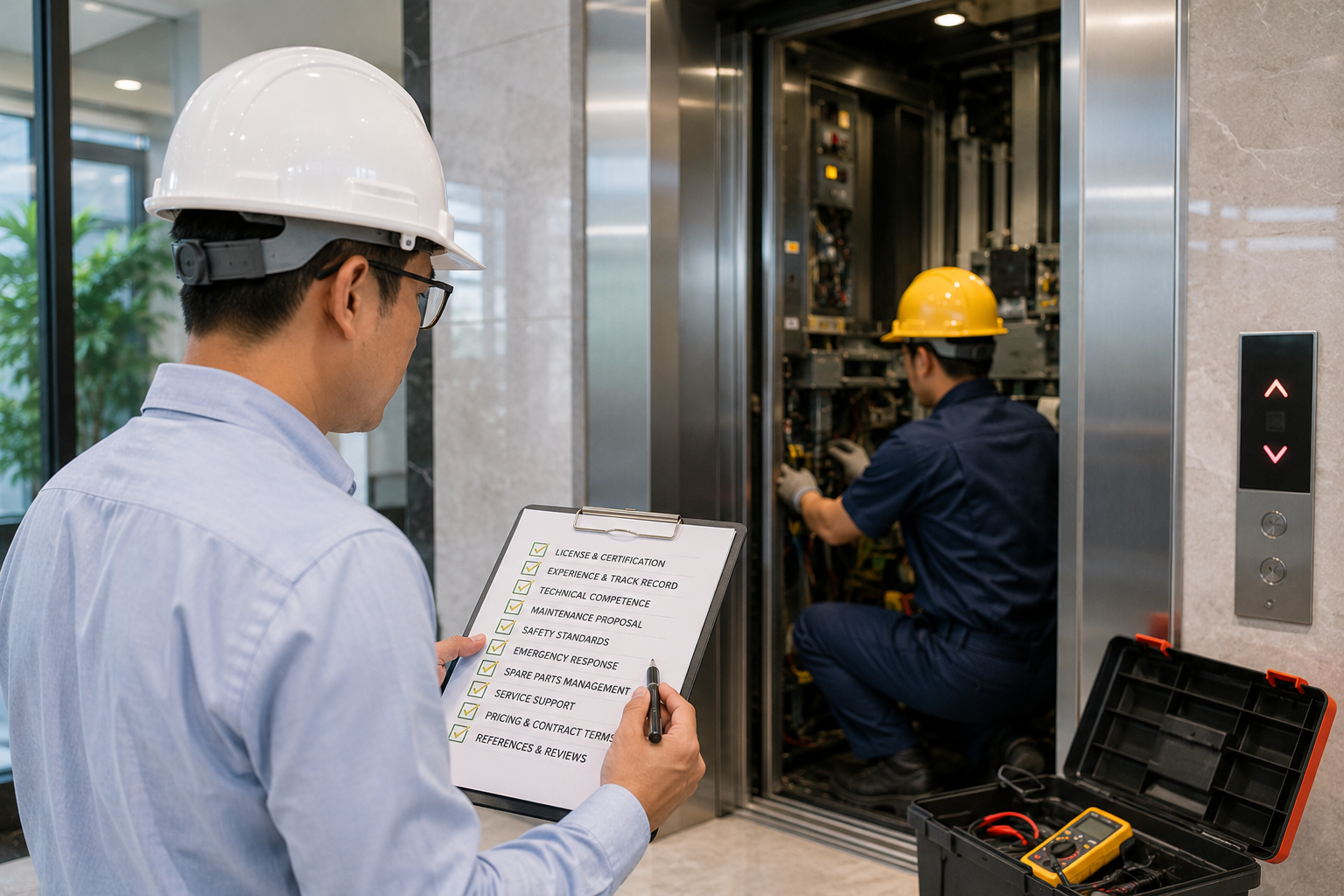
Most management committees discover the hard way that a lift contractor’s brochure tells you almost nothing useful. Two firms can both wave the same registration certificate and still deliver wildly different service, safety, and pricing. So how does an MCST move from a glossy pitch to a decision it can defend at the next AGM? It comes down to a handful of checks, done in order, before anyone signs anything.
Table of Contents
Confirm the registration is real and current.
Singapore law settles the first question for you. Under the Building Control (Fixed Installations) Regulations 2025, only contractors registered with the Building and Construction Authority may maintain or alter lifts, and the legal duty to engage one sits with the building owner. Skip that and your committee carries the liability if something goes wrong.
Verify at the source, never on a contractor’s website. The BCA keeps a free public directory you can search by company name or Unique Entity Number in under five minutes. Check three things while you’re there: the status reads active rather than expired, the category matches your work (maintenance and alteration or replacement are listed separately), and the validity date hasn’t quietly passed. A firm that was registered last year may have lapsed since. For extra assurance, run the UEN through ACRA’s business registry to confirm the company is trading and to sanity-check claims about how long it has been around. A three-month-old entity advertising a decade of experience deserves a second look.
Ask for the registration certificate too. A reputable contractor hands it over without fuss. Evasiveness here tells you plenty.
Look past the company to the people on your roof
Registration covers the business. It says nothing about the technician who actually opens your machine room. The recognised credential for that person is either a Nitec in Built Environment (Vertical Transport) or an ITE Certificate of Competency in Lift Maintenance, and a fast-growing firm may carry technicians at very mixed levels of certification. The sharper question isn’t “are your technicians qualified?” but “what share of your field technicians are certified, and exactly who will be assigned to our building?” Vague reassurance is a non-answer.
Safety that’s been audited, not just asserted
This is where bizSAFE earns its keep. Run by the Workplace Safety and Health Council under the Ministry of Manpower, it’s a tiered scheme, and the levels are not equivalent. Level 1 means a director sat through a three-hour workshop. Level 3 means the company built a documented Risk Management Plan and had it checked by an MOM-approved auditor. For lift work, where crews deal with confined spaces, live electrical systems, and machine rooms at height, Level 3 is the benchmark tenders tend to demand, because it shows those specific hazards have been assessed and externally verified. Independent specialists such as Hin Chong hold Level 3; whoever you shortlist, ask for the certificate and check its validity date.
Who actually handles your Permit to Operate
Every lift needs a valid Permit to Operate, and renewing it isn’t something your contractor does alone. A Lift and Escalator Inspector, registered with the Institution of Engineers Singapore, carries out the inspection. A Specialist Professional Engineer in the lifts and escalators discipline, certified by the Professional Engineers Board, signs off the renewal. Your contractor’s job is keeping the lift maintained and inspection-ready. Not every registered firm has an inspector on the team or on retainer, so ask plainly how PTO renewal works with them. A contractor who can’t explain it clearly may be leaving you to arrange it yourself.
Brand coverage and the parts trap
If your development runs lifts from several manufacturers, your contractor has to handle all of them. An OEM’s service arm is trained on its own equipment and typically services that brand alone, using proprietary parts that tie you to its supply chain and pricing. An independent working with non-proprietary systems can cover the major brands found in Singapore buildings, including Schindler, Otis, KONE, Mitsubishi, Fujitec, TKElevator, and Toshiba. That flexibility matters most in older or mixed-use developments where different blocks carry different installed brands; a single-brand firm either can’t cover your whole portfolio or quietly subcontracts the rest, which blurs accountability.
The contract is where lock-in hides
Read the agreement before you sign, and read it for traps. Auto-renewal clauses can roll you into another one or two-year term unless you give written notice thirty to sixty days out. Proprietary-parts clauses chain you to one supplier indefinitely. Early-termination penalties that swallow the full remaining contract value signal a firm relying on lock-in rather than service to keep clients. And watch for woolly definitions of “maintenance” that let a contractor bill separately for work any reasonable person would call routine. Ask for an itemised list of what each visit includes and what triggers an extra charge.
One more compliance point lives in the contract conversation: the Maintenance Control Plan. BCA requires one per lift, kept with the lift’s records and produced on request. The owner is accountable for it; the contractor executes it. Ask a shortlisted firm to walk you through how it creates and updates MCPs. A clear process signals operational maturity; a shrug signals risk to your compliance.
Test the relationship before you commit
How a contractor treats you while chasing your business is the best preview of life after signing. Before asking for a quote, get each shortlisted firm to do a condition assessment on site, and watch how they work: punctual arrival, proper identification, an actual inspection of the machine room rather than a glance at the cabin, written findings instead of vague verbal opinions, and plain-language explanations rather than jargon meant to alarm.
When the quotes land, normalise them before comparing. Make each one spell out visit frequency, what a standard visit covers, what counts as an extra, response-time commitments in hours, and any annual price escalation. A quote that looks cheap because it quietly excludes call-out labour isn’t a fair match for a comprehensive programme. Then run a small test: email two or three pointed questions and time the reply. A firm that takes four days to answer a pre-sales query won’t get faster once trapped-passenger calls and renewal deadlines are on the line.
Building owners comparing lift maintenance services by Hin Chong against other lift maintenance companies should hold every shortlisted contractor to this same sequence. Registration gets a firm onto your list. The checks that follow are what tell you whether it belongs there.